
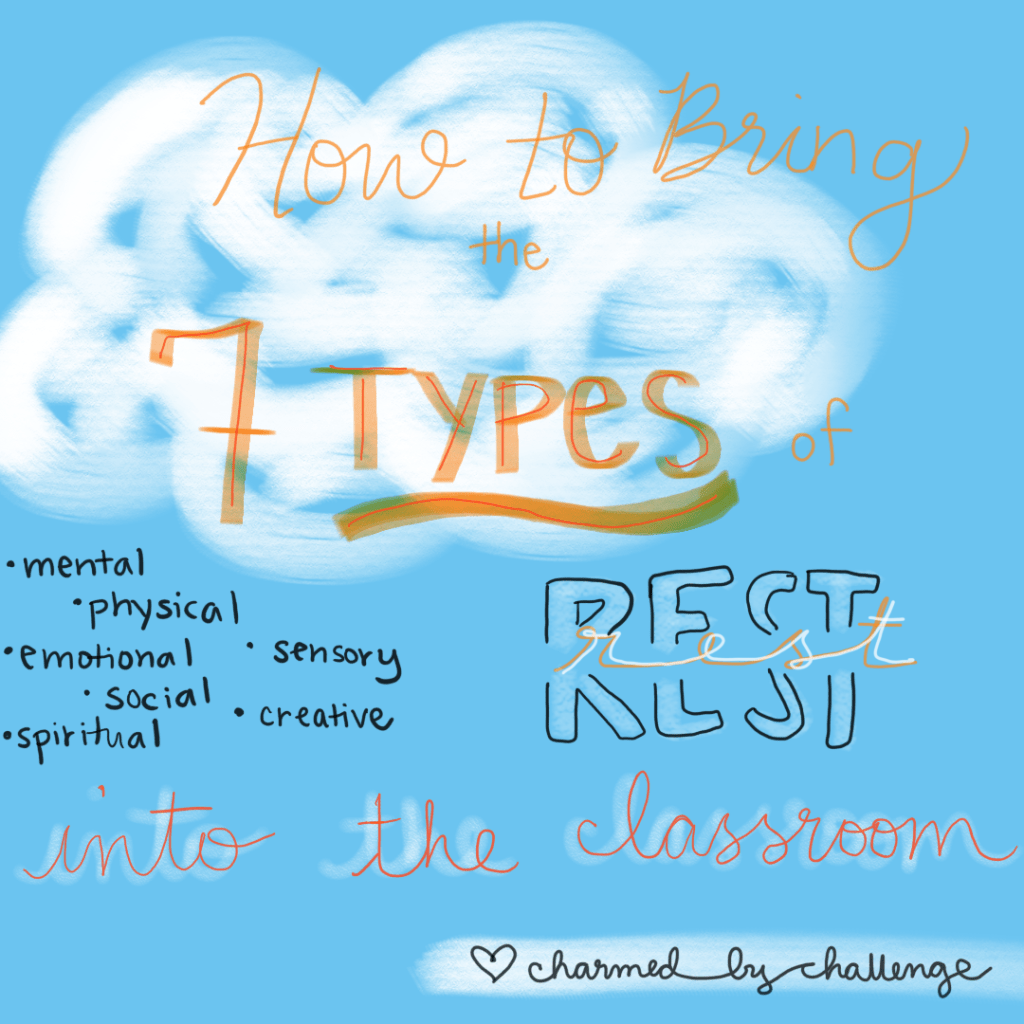
Recently, I heard the TED Talk by Dr. Saundra Dalton-Smith on the 7 Types of Rest that every person needs. This particular talk shares the types of rest and how we as adults can make time and space for rest. In the talk she heavily focuses on how to bring rest into your workday and your workplace, thinking of traditional office spaces. This got my thinking about how to create these types of rest during a school day for teachers and for students. Schools can be hectic places with schedules dictated seemingly by everyone except you as the teacher and multiple draws on our resources. I already wrote a blog post on how I try to create a calming classroom, but after hearing about these specific 7 types of rest, I was curious how considering all of those types could help to shape a classroom environment.
1. Physical Rest
The opening to Dr. Dalton-Smith’s TED talk explains that we cannot equate sleep with rest; sleep does, however, fall into physical rest. Since napping is not even a thing in most Kindergarten classrooms anymore, we need to reach for other forms of physical rest. One of my favorite ways to build this in is through visualization exercises and meditations. A loving-kindness meditation is a great place to start. I also love having kids visualize a nature scene such as sitting under a tree or looking at a stream or putting your feet in the sand by the ocean. These take only a moment and students can rest their head on their desk. This type of activity can really lower the temperature in a room as well.
Your body does not have to be still to be more physically rested. Going for a walk or stretching or doing a yoga pose can also be an effective form of physical rest. Instead of rushing to the bathroom and checking my mailbox in the office, I can walk more slowly and calmly and get something out of that task for myself instead of just rushing to get to the next activity.
2. Mental Rest
This is a difficult type of rest to get as a teacher. Our brains are on all the time trying to monitor 30 other people. I know I will feel guilty for taking a mental break at my desk because it feels like the odds are high that something will go wrong or there will be some negative social interaction between students the moment I take a deep breath in my own little world. The way I build this in for myself, though, is through the concept of buffer time. If I plan in such a way that I don’t have to fill every second but I allow for 5 minute transitions between subject areas and activities, then I have the time to not feel so rushed I can’t think what to do next. I personally can get a bit of mental rest when I show a 5 minute video to explain a concept or we sing along to a song (I personally love Hopscotch videos for my 2nd graders!). Because we often listen to the same song multiple times, this is not particularly taxing for students, either.
I think one of the best ways to build in mental rest for students is just wait time. Giving extra wait time (which may feel excessive if you’re not used to it) will allow students to fully absorb a question and anticipate responses.
3. Emotional Rest
Every day, I have a 10 minute quiet time. My rules for quiet time are that you are doing an independent activity and you stay in one spot – whether that’s at your desk, in the classroom library, on the rug, etc. Independent activities can include drawing, resting, writing, catching up on classwork, continuing a project you enjoy, reading, playing with play-doh, etc. Students love having this time to themselves to do their own activity. Because it is independent, it offers both emotional rest and social rest. I personally also get some emotional rest because I do not have to expend as much energy during this time. It gives me the opportunity to check in with a student, support conflict resolution from lunch or recess as quiet time happens mid-day or later in the day, give a makeup quiz for a student who was absent, check my email, etc. Quiet Time is a Responsive Classroom practice, and I can’t imagine not having it built into my day.
Another way I build in emotional rest is through morning meeting and closing meeting. These are also Responsive Classroom practices. These meetings create opportunities for classmates to share feelings, concerns, worries, joys, and thoughts about experiences with one another. The Sharing component of morning meeting offers up time and space to share about your day, your opinions, and anything else that might be on your mind. Students can take turns and share as much or as little as they like. I love hearing about students’ lives through this time. You can learn a lot about morning meetings from other posts I’ve written and especially on ResponsiveClassroom.org. There’s even a whole Morning Meeting Book I highly recommend.
4. Sensory Rest
I find school buildings can overload my senses. I’m an introvert and highly sensitive person (HSP), and those personality traits can create some difficulty in loud, crowded environments. I have calmer lights and soft colors and fabrics around my classroom. I try not to put too many posters or intense decorations up because it overwhelms me. I keep half of the fluorescent lights off all of the time and sometimes I turn them all off if we are doing an activity for which only sunlight from the windows suffices. These strategies lessen the burden on my senses.
For students, I find that they often enjoy working with quiet music or nature sounds in the background. I like the site noisli for nature sounds as well as youtube videos of classical music set to nature backgrounds. I enjoy finding music rooms on youtube that are themed to holidays as well such a spooky house for Halloween or a snowy cabin scene in January. Those are an easy way to infuse a little joy for me as well since I enjoy the passing of seasons.
5. Creative Rest
The 10 minutes of quiet time I described to support emotional rest I think also can support creative rest depending on the task an individual chooses. One part of lesson plans that gets forgotten, cut because of time, or just ignored because it feels repetitive and uninteresting is reflection. I used to think reflection was a nice to have and didn’t need to happen every day, certainly not every lesson. I have found that I enjoy giving students longer periods for reflection on occasion instead of trying to shove it into 30 seconds at the end of a lesson just because I need to have it. I also have found sharing out at the end of a lesson to be an enjoyable way to build in reflection. My thinking really changed with my professional development surrounding thinking routines. I love thinking routines. As I read about creative rest, I was thinking how these routines to build understanding are a method to processing information. For creative rest, I think we just need time to process the intake of our day and reflect on what we are learning and what’s going on through our mind. This time is vital to actual learning in the classroom.
6. Social Rest
Again, I think quiet time is a great way to build in social rest. Another cornerstone of my classroom is the idea of take a break. I will send students to take a break as a positive time-out for classroom management of behaviors, but I also allow (and encourage) students to take a break on their own. If students are getting frustrated with a classmate during groupwork or someone is bothering them, they can go take a break to get a social break from that person. It can work wonders to just step away for a moment. We can also teach students to take a break from someone at recess or to allow themselves space to be by themselves or to seek out company if they need to talk.
7. Spiritual Rest
I would consider myself to be a spiritual person. I am also religious, but I find a lot of joy in prayer and just thinking about creation and being in nature. Those moments are extremely important to my faith. In the TED talk, Dr. Dalton-Smith mentions putting up images of nature in your workplace or places that give you inspiration. I mentioned above how I enjoy putting up images of nature, using nature sounds, and using music in my classroom. I think these also contribute to spiritual rest. Getting outside could be a great way to encourage spiritual rest. I love playing games outside with students, going for a nature walk, studying butterflies in our science unit, growing flowers in the garden, writing outside on our picnic tables, and reading under the trees. I have always loved putting up student artwork. I start the year with students painting self portraits and putting up photographs of them reading at home, and these two things have always made me love the classroom environment. I think these are ways I’m supporting spiritual rest.
I was so energized learning about these 7 types of rest, and I can’t wait to be more intentional to include them all in my own day as well as my students’ days in the classroom. I hope you find this school year to be restful and rejuvenating!
 Charmed by Challenge
Leave a comment